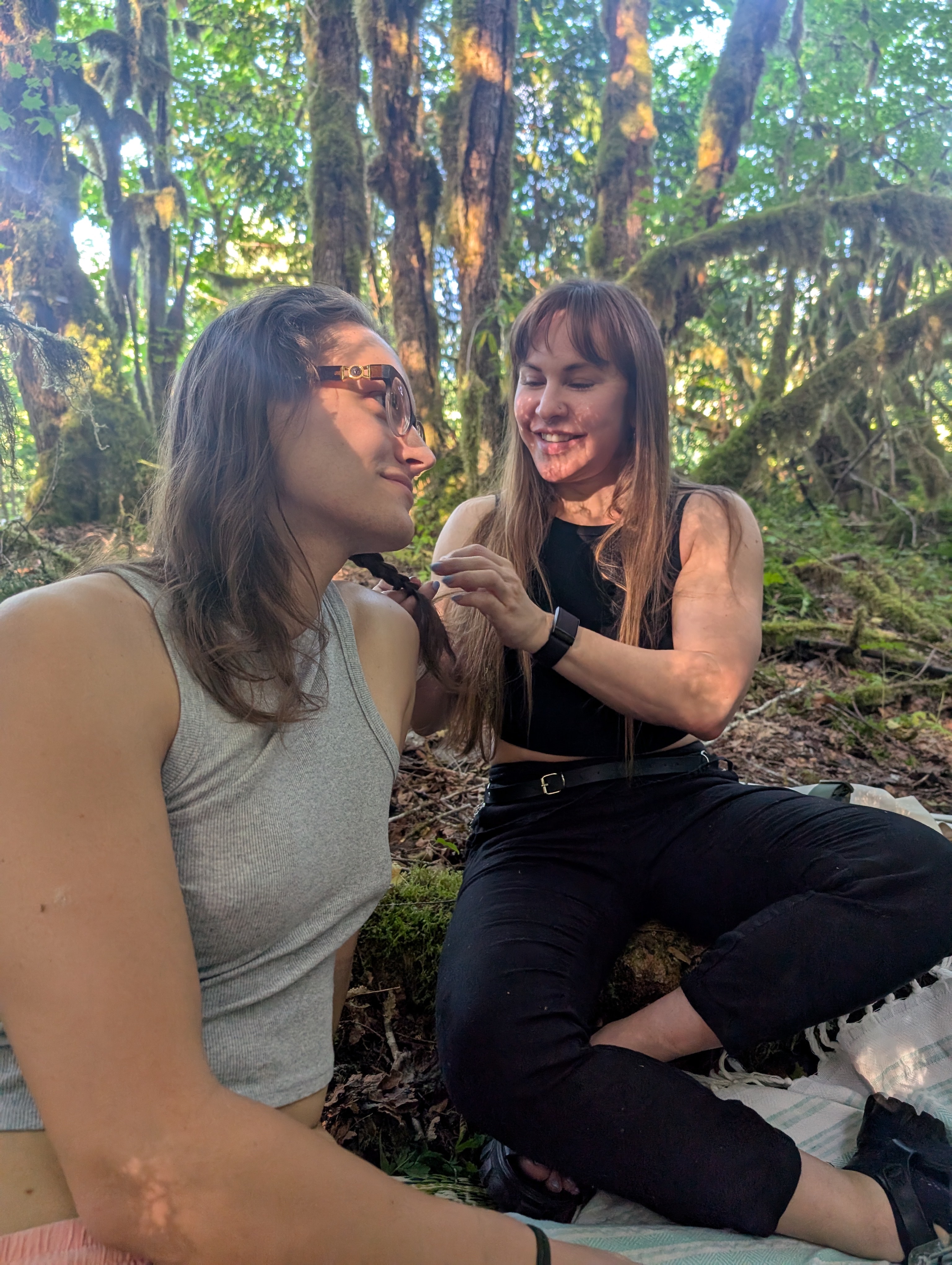
I remember the first time someone described their polycule to me in a clinical context — the particular care with which they named each connection, the way their voice changed texture when they talked about the people they loved and the people those people loved. There was something in the complexity itself that felt almost botanical to me: a living system with many roots, many branching connections, each one growing toward its own light.
I came to polycule coaching not as an outside observer but as someone inside these structures myself. That matters, I think. Not because lived experience replaces clinical training, but because there is a quality of knowing that comes from having been the person in the triad trying to hold your feelings of jealousy with grace, or the hinge partner at 11pm mediating a conflict between two people you love, or the metamour trying to figure out how to be in relationship with someone you didn't choose but who is now, undeniably, part of your life.
What I Mean When I Say Polycule Coaching
I want to say clearly what polycule coaching is not: it is not couples coaching with more chairs. The frameworks that govern dyadic work — the Gottman Method, attachment-based couples approaches, even most of the language we use for "the relationship" — are built around two people. They assume a container of two. Polycule coaching asks for something different: the capacity to hold a constellation.
A polycule might be a triad in which all three people are in relationship with each other. It might be a network of six, with various dyadic connections and metamour relationships that were never chosen but are nonetheless real and significant. It might be one person at the center of multiple connections, managing more relational bandwidth than most people would recognize as sustainable. Whatever the configuration, these structures have their own intelligence, their own pressures, their own forms of beauty and difficulty.
I will not pathologize the structure. That is perhaps the most important thing I can say. Polyamory is not a symptom. It is not an attachment disorder. It is not something you are doing because you are afraid of commitment — or if it is, that's a question worth exploring with curiosity and without shame, the way any relational pattern deserves to be explored. My job is not to help you become monogamous. My job is to help you become more fully yourself, within the relationships you are actually building.
Attachment in Non-Dyadic Structures
Jessica Fern's Polysecure does something I haven't seen done as well elsewhere: it takes attachment theory — a framework built almost entirely around dyadic relationships — and asks what it looks like when a person is building secure attachment across multiple relationships simultaneously. Her answer is that it's more complex, not less. Each relationship has its own attachment dynamic. A person might be securely attached in one partnership and anxiously attached in another, not because they are inconsistent, but because attachment is relational — it lives between people, not only inside them. Fern's HEART framework offers a way of thinking about what each relationship needs in order to feel secure, which is different from asking what the individual needs in the abstract.
This is something I hold when working with polycules. The question isn't just "how is each person doing?" — it's "how is each dyad doing, and how are the dyads relating to each other?" A polycule in which every individual feels loved but every dyad feels unseen is still a polycule in distress.
What Polycule Coaching Actually Looks Like
The format shifts depending on what is needed. Sometimes I work with one person individually, helping them track their own experience within the larger system — what they're carrying, what they're avoiding, where their nervous system is signaling something they haven't quite voiced yet. Sometimes I work with two people in a specific dyad, which may itself be a strand within a larger constellation. And sometimes the whole polycule, or a significant part of it, comes into the room together.
That last format is the one I find most alive and most demanding. When multiple people are present, I am tracking multiple nervous systems, multiple attachment histories, multiple bids for attention and visibility — and I am doing this while also watching for whose voice is going quiet. In any group dynamic, there is a risk that the loudest distress or the most articulate person absorbs the room. Part of my job is to be the container that makes sure everyone gets to be genuinely present.
"The polycule has its own intelligence. My role isn't to impose order on it — it's to help each person in it hear themselves, and then hear each other."
Themes That Arise
Every polycule is different. And yet certain themes appear again and again, and I find it useful to name them not as problems but as the natural weather of these structures:
- Jealousy as information. Jealousy is nearly universal in polyamory, and nearly universally misunderstood — including by the people experiencing it. I have a story that jealousy is almost never really about the surface situation. It is pointing toward something deeper: a fear, an unmet need, an old wound that got activated. Helping people decode their jealousy, rather than suppress it or be consumed by it, is often some of the most valuable work we do together.
- The labor of maintenance. Maintaining multiple loving relationships takes time, emotional bandwidth, and coordination that is often invisible to everyone including the person doing it. Burnout is real. So is the experience of feeling like you are managing relationships rather than living inside them. I take the labor of polyamory seriously — it's real, and it matters.
- Hierarchy, power, and the people who don't have it. When some relationships carry more official weight than others, power dynamics emerge that deserve careful attention. Who gets to make decisions? Whose needs are treated as primary? Who absorbs the cost when the structure changes?
- Metamour relationships. You didn't choose your metamour. And yet the texture of that relationship — whether it is warm, cool, collaborative, or fraught with unspoken competition — shapes the whole system. These relationships deserve real attention in their own right.
- Transitions. When one relationship grows, deepens, shifts, or ends, the whole constellation reorganizes. Holding those reorganizations with care — acknowledging what is being gained and what is being grieved, in every direction — is some of the most tender work I do.
On the Beauty of It
I want to end here, because I think it matters: polycule coaching does not have to be about problems. Some of the most meaningful sessions I have been part of have been about metabolizing something good — a new connection, a deepening, a moment of unexpected care that moved through the whole system. There is real value in helping people receive the life they are building. To take it in, rather than always bracing for what might go wrong.
Polyamory, practiced with intention and with care, is an experiment in love. That deserves to be witnessed.